Turning Logistics Data into a Performance Lever
Logistics outsourcing has become the norm for many e-commerce brands: rapid growth, international expansion, omnichannel commerce, seasonal peaks… all of these challenges make working with 3PL partners essential.
But while logistics execution may be outsourced, accountability for performance remains entirely on the shipper’s side.
Order preparation times, inventory accuracy, delivery reliability, SLA compliance, dispute management: all of these challenges require full, reliable and actionable visibility which is often difficult to achieve when data is scattered across multiple systems and service providers.
This is exactly where Spacefill 3PL Connect transforms the shipper–3PL relationship. By connecting and normalizing the IT systems of shippers and logistics providers, Spacefill creates a shared data foundation that turns KPIs and dashboards into true strategic management tools, rather than simple reporting outputs.
1. The shipper’s challenge: data exists, but visibility is fragmented
In theory, outsourcing logistics enables shippers to gain agility and execution capacity.
In practice, it often leads to a loss of visibility over actual operational performance.
Many e-commerce brands face recurring issues such as:
- 3PL-provided reports that lack consistency, are delivered at varying frequencies, and are difficult to compare
- Performance indicators calculated using different methodologies from one 3PL to another
- Heavy reliance on manual Excel files, which are time-consuming and error-prone
- Limited access to real-time operational visibility
- Performance gaps identified after the fact, once the operational or customer impact has already occurred
Consequences for the shipper
This fragmentation of information leads to several pitfalls:
- Logistics management becomes largely reactive rather than predictive
- Decision-making relies on partial or outdated data
- Objective evaluation of logistics providers’ performance becomes difficult
2. Logistics KPIs: what shippers really need to measure
To effectively manage outsourced operations, shippers need a cross-functional, business-oriented view, not just an operational one.
Key KPI categories for e-commerce shippers
Operational performance KPIs:
- Average order preparation time
- Cut-off time compliance
- On-time order dispatch rate
- Volumes processed per day / week / month
Reliability & quality KPIs:
- Picking error rate
- Inventory discrepancies
- Inventory count accuracy
- Number and type of disputes
Transportation performance KPIs:
- Actual delivery times vs. promised delivery times
- On-time delivery rate
- Transportation incidents
Business & contractual KPIs:
- SLA compliance
- Cost per order / per parcel
- Performance by warehouse or by logistics provider
- Performance trends over time
The real challenge is not just having access to these KPIs, but being able to cross-reference, contextualize and benchmark them based on a single, shared data source between shippers and their logistics partners.
3. Spacefill 3PL Connect: a single data foundation for all stakeholders
Centralizing data flows to ensure reliable KPIs
With 3PL Connect, Spacefill connects in real time:
- Shippers’ systems (ERP, CMS, OMS, marketplaces)
- 3PL tools (WMS, TMS, internal systems)
- Operational flows (orders, inventory, shipments, returns, disputes)
Every logistics event becomes actionable data, automatically synchronized and interpreted in a consistent way, regardless of the source system.
By positioning itself above ERP, WMS and TMS systems, Spacefill 3PL Connect does not replace existing tools it reconciles them.
This centralization and normalization enable the production of reliable KPIs, consistent dashboards, and most importantly, a shared and aligned view of performance between shippers and logistics providers.
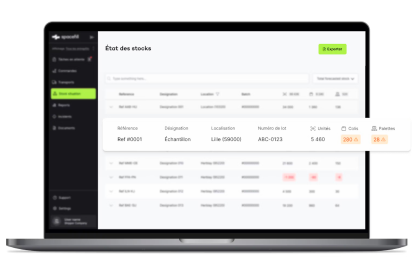
Beyond performance indicators, this data foundation provides real-time operational visibility across inventory, orders and deliveries. This visibility allows shippers to anticipate bottlenecks, prioritize corrective actions and make better trade-offs well before issues impact the end customer.
4. Dashboards designed for a shipper perspective, not just operations
A consolidated view of all outsourced logistics
One of the key benefits of Spacefill dashboards is that they give shippers a global view of all their operations—even when spread across multiple warehouses, multiple 3PLs, multiple countries and multiple sales channels—made possible by the data connection and normalization performed by 3PL Connect.
E-commerce brands no longer need to jump between tools and reports: everything is accessible from a single interface.
Multi-level dashboards
Spacefill dashboards offer:
- A high-level view for strategic steering
- A detailed view by provider, site, time period or operation type
- Comparative analysis between 3PLs or across different periods
This makes it easy to quickly identify underperforming partners, understand the root cause of operational slowdowns, or anticipate risks such as stockouts or capacity saturation.
5. From reporting to decision-making
Moving from hindsight to anticipation
With Spacefill dashboards, KPIs are no longer just about looking backwards:
- Deviations are detected earlier
- Trends become visible
- Critical thresholds can be identified quickly
Shippers can act before customer impact becomes visible.
A key tool for 3PL performance reviews
Spacefill dashboards also become a central asset for monthly performance reviews, partner discussions, contract renegotiations and volume reallocation decisions.
With shared, objective and transparent data, the shipper–3PL relationship becomes:
- More fact-based
- More constructive
- More focused on continuous improvement
6. A strategic lever for fast-growing e-commerce brands
For fast-growing brands, Spacefill KPIs and dashboards make it possible to scale faster without losing control, onboard new 3PLs without adding complexity, protect the customer experience despite operational complexity, and turn logistics data into a competitive advantage.
Logistics is no longer just a cost center it becomes a differentiation lever.
Conclusion: managing outsourced logistics as a strategic asset
With Spacefill 3PL Connect, KPIs and dashboards are not just reporting tools.
They become a true control tower for e-commerce shippers, enabling them to regain visibility, objectively assess performance, align all stakeholders around a single source of truth, and make better decisions faster.
With Spacefill, shippers manage their operations as if they were in-house, with the added flexibility of 3PL outsourcing.
FAQ :