The role of logistics service providers has evolved significantly. Long viewed as simple executors, 3PLs are now at the heart of operational performance, customer experience, and the growth of the brands they support. This evolution comes with a new requirement: the ability to measure, explain, and share performance clearly and continuously.
In this context, KPIs and dashboards are no longer just reporting tools. They have become a shared language between 3PLs and shippers, a foundation of trust, and a powerful differentiation lever. This is precisely the vision behind Spacefill.
From internal control to demonstrable performance
For a 3PL, the first priority remains operational control. Performance indicators help teams understand what is really happening in the warehouse, identify friction points, and secure client commitments. Historically, the issue has not been a lack of data, but rather its fragmentation and lack of consistency.
In many logistics organizations, performance is still monitored through:
- isolated WMS data,
- manually rebuilt Excel files,
- client reports produced after the fact.
This approach makes performance difficult to interpret and slows down decision-making.
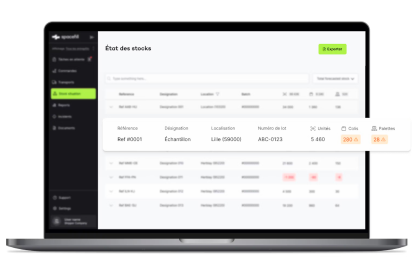
With Spacefill, logistics data is continuously synchronized from both shipper and 3PL systems, giving providers a unified and reliable view of their operations.
KPIs as a tool for day-to-day operational control
For 3PL teams, KPIs are first and foremost an efficiency lever. They make it possible to track the real operational pace, assess workload, and anticipate pressure points. This granular visibility is essential to adjust resources, prioritize activities, and secure delivery commitments.
Spacefill dashboards provide real-time visibility into key dimensions such as:
- processing lead times,
- picking and preparation quality,
- inventory discrepancies,
- incidents and disputes.
These indicators, contextualized and comparable over time, offer a clear and actionable view of performance. As a result, 3PLs can intervene quickly before deviations turn into customer dissatisfaction.
Making performance clear and actionable for shipper clients
One of the major challenges for logistics providers is client communication. Shippers increasingly expect greater transparency, not to monitor for control, but to collaborate more effectively. Yet many tensions still arise from misunderstood figures, inconsistent calculation methods, or data shared too late.
Spacefill enables 3PLs to share clear, consistent dashboards with their clients. KPIs are calculated from the same data sources, using shared rules, which significantly reduces ambiguity. Conversations become more objective, shifting from justification to continuous improvement.
In this model, the 3PL no longer reacts to reporting requirements it structures and anticipates them. It becomes a true performance partner, capable of explaining its choices, constraints, and results.
A more mature and balanced client relationship
This transparency fundamentally reshapes the relationship between 3PLs and shippers. KPIs are no longer perceived as control tools, but as a framework for dialogue. They help address the right questions: Should SLAs be adjusted? Should committed volumes be reviewed? Does the organization or cut-off structure need to change?
With shared, reliable data, decisions become collective and rational. The 3PL gains credibility, while the shipper gains visibility. Each party better understands the other’s constraints, fostering more sustainable, long-term partnerships.
Dashboards as a differentiation lever for 3PLs
In an increasingly competitive logistics market, the ability to demonstrate performance has become a strategic advantage. Providers that can offer a clear, structured, and accessible view of their KPIs naturally stand out.
Spacefill dashboards allow 3PLs to showcase their expertise not only to existing clients, but also in commercial contexts such as tenders, pre-sales phases, and contract discussions. Data becomes a tangible proof point, far more powerful than generic promises.
This approach also strengthens the 3PL’s ability to support client growth. By mastering their KPIs, providers can anticipate volume ramp-ups, secure operations, and demonstrate their ability to scale.
Towards data-driven, collaborative logistics
The vision behind Spacefill is one where data flows as smoothly as goods. KPIs and dashboards are no longer isolated tools, but the foundation of effective collaboration between shippers and 3PLs.
For logistics providers, this represents a major opportunity: moving from an execution role to that of a strategic partner capable of managing, explaining, and continuously improving performance over time.
Conclusion
With Spacefill, KPIs and dashboards go far beyond reporting. They enable 3PLs to regain control over performance, strengthen client relationships, and differentiate themselves in a demanding market.
In an environment where transparency has become the standard, providers that can turn data into a tool for steering and collaboration gain a decisive competitive edge.
FAQ :