Modern logistics operations rely on an increasing number of systems and external partners.
ERPs manage commercial data, WMS handle warehouse execution, TMS coordinate transport flows, while logistics providers operate their own tools and processes.
The real challenge isn’t the lack of technology.
It’s the lack of coordination between all these systems.
Spacefill was built to solve this exact problem by connecting shippers’ ERP, CMS, and marketplaces with the WMS and TMS used by 3PLs within a single, unified logistics ecosystem.
This article explains how Spacefill works in practice and why its integration model is fundamentally different from traditional approaches.
Why logistics systems struggle to work together
In many organisations, logistics systems have been added over time without a clear overall architecture.
This often leads to situations such as:
- an ERP connected to some outsourced warehouses, but not all
- multiple 3PLs using different WMS, each requiring a custom setup
- transport coordination handled outside core systems
- fragmented visibility once execution is outsourced
Individually, these tools may work well.
Together, without a shared integration layer, they create friction, delays, heavy manual workloads, and inconsistent visibility across teams.
Why traditional EDI integrations no longer scale
EDI is still the most common integration model in logistics.
Each system connects directly to another through dedicated data flows and custom mappings.
In practice, this quickly becomes a problem:
- integrations are hard to reuse
- every new partner requires new development work
- data formats vary from one connection to another
- changes in one system ripple across multiple integrations
- operational teams become highly dependent on IT
As the logistics network grows, this architecture becomes fragile, slow to evolve, and expensive to maintain.
Spacefill’s integration model: a centralized hub
Spacefill replaces point-to-point integrations with a centralized integration hub.
Instead of connecting systems to each other, all tools and partners connect to Spacefill.
The platform acts as an orchestration layer between:
- internal systems such as ERP, OMS, CMS, and marketplaces
- WMS used by 3PLs
- transport tools and carriers
This approach simplifies integrations while giving operations teams far more control.
Step by step: how Spacefill connects ERP, CMS, marketplaces, WMS, and TMS
1. Connecting internal systems
Spacefill first connects to the company’s internal systems, typically:
- ERP
- OMS
- e-commerce platforms
- marketplaces
Orders, master data, and key business information are synchronized via API or EDI, ensuring Spacefill always works with up-to-date data.
2. Connecting 3PLs and their WMS and TMS
Each 3PL connects its own WMS and/or TMS to Spacefill.
This allows the platform to:
- receive inventory updates
- send standardized picking and fulfilment instructions
- track order execution in real time
- access delivery statuses
Different WMS can coexist without adding complexity for the shipper or the brand.
3. Standardising and normalising data
A core function of Spacefill is data normalisation.
Regardless of the source, incoming data is transformed into standard logistics objects, such as:
- orders
- inventory movements
- deliveries
- incidents
This removes inconsistencies and provides a single, shared view of operations.
4. Automating order intake and processing
In many organisations, orders still arrive in unstructured formats.
Spacefill uses AI to automatically extract order data from:
- emails
- PDF documents
- Excel files
Once extracted, orders are converted into standard workflows and automatically routed to the relevant 3PL’s WMS.
Manual re-keying disappears, and errors drop significantly.
5. Orchestrating execution and managing exceptions
As 3PLs execute orders, Spacefill tracks progress across all warehouses and partners.
When issues occur delays, stock discrepancies, delivery problems—the platform centralises exception management.
Teams can then:
- identify issues earlier
- assign them to the right partner
- collaborate directly within the platform
- maintain full traceability
A single, unified view of logistics operations
By centralising integrations and workflows, Spacefill becomes a single source of truth for logistics operations.
Users gain:
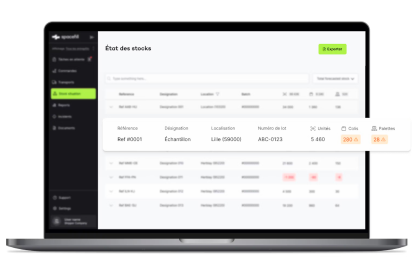
- real-time visibility on multi-warehouse inventory
- end-to-end order tracking across all 3PLs
- transport and delivery visibility
- shared performance metrics
This replaces fragmented dashboards and manual reporting with a clear, operational view.
More than a traditional integration middleware
While Spacefill handles integrations, it goes far beyond a classic middleware.
Key differences include:
- data models designed specifically for logistics
- built-in operational workflows
- native collaboration with 3PLs
- AI-driven order automation
- interfaces built for operational teams
Spacefill is designed to run logistics operations day to day not just to move data between systems.
Who benefits from Spacefill?
Brands and shippers
- full visibility over outsourced logistics
- standardised processes across partners
- reduced operational risk
- faster scalability of the logistics network
- improved customer satisfaction
3PL providers
- simpler client onboarding
- reduced integration complexity
- stronger collaboration with shippers
- clearer performance reporting
- higher operational efficiency
Logistics and supply chain teams
- fewer manual tasks
- better data quality
- faster issue resolution
- more time for optimisation
Key takeaways
- logistics systems need a unified integration layer to scale
- point-to-point integrations don’t hold up over time
- Spacefill connects ERP, WMS, TMS, and 3PLs through a central hub
- standardisation and automation sit at the core
- integration becomes a driver of operational performance
FAQ :