With the multiplication of sales channels, the growing outsourcing of logistics, and increasing operational complexity, choosing an Order Management System (OMS) has become a strategic challenge for many companies.
But given the wide variety of solutions available on the market, one question comes up again and again: what is the best OMS?
The answer is not universal. It primarily depends on your logistics model, your partners, and your level of operational maturity.
OMS: A Key Tool for Order Orchestration
An Order Management System is a software solution that enables companies to manage the entire order lifecycle, from order creation to delivery, including inventory management, returns, and exception handling.
An OMS plays a central role in the logistics ecosystem, as it connects:
- sales channels (e-commerce, marketplaces, B2B, EDI, etc.)
- internal systems (ERP, CRM)
- logistics systems (WMS, TMS, 3PLs)
Its main objective is to centralize information, automate workflows, and ensure smooth order execution, even in complex environments.
Why the Best OMS Is the One That Adapts to Your Outsourced Logistics
For a long time, OMS solutions were designed for relatively simple logistics organizations: a single main warehouse, one WMS, few external actors, and mostly centralized flows.
Today, reality looks very different. Companies now have to deal with:
- multiple warehouses, often outsourced
- several logistics service providers (3PLs)
- both B2B and B2C flows at the same time
- high expectations in terms of delivery speed and traceability
In this context, an unsuitable OMS can quickly become a source of friction:
- lack of visibility on outsourced inventory
- time-consuming manual exchanges between brands and 3PLs
- routing or prioritization errors
- proliferation of tools and data sources
The best OMS is therefore the one that adapts to the company’s operational reality, not the other way around.
The Limitations of Traditional OMS Solutions
Traditional OMS platforms are often designed as “closed” systems, centered around a single environment. They usually assume that:
- all warehouses use the same WMS
- flows are standardized
- Collaboration with logistics partners is limited and almost non-existent.
In multi-3PL environments, these solutions quickly show their limits.
Implementation becomes complex, integrations are heavy, and visibility remains fragmented across stakeholders.
As a result, despite having an OMS in place, teams still rely on emails, spreadsheets, or manual exports to share information.
An OMS Designed for Logistics Collaboration
This is precisely the challenge Spacefill was designed to address.
Rather than replacing existing tools, Spacefill acts as an orchestration and collaboration layer between all players in the logistics chain.
The approach is based on a simple principle: connect existing systems, centralize information, and automate exchanges, without forcing logistics providers to change their tools.
Concretely, an OMS like Spacefill enables you to:
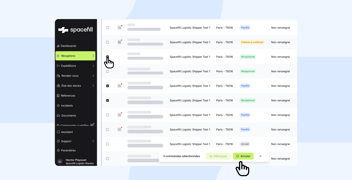
- centralize all orders, regardless of their sales channel
- synchronize inventory across multiple warehouses in real time
- orchestrate order routing based on business rules (SLAs, location, capacity, priorities)
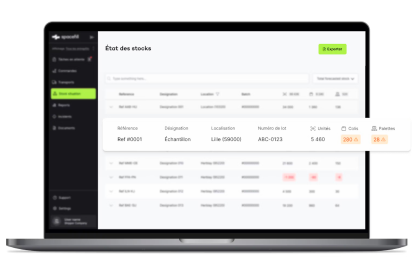
- provide shared visibility to brands and 3PLs
- automate data exchanges and reduce manual tasks
The OMS thus becomes a true control tower, rather than just a tracking tool.
Visibility as a Key Criterion
One of the most important criteria when evaluating an OMS is the level of operational visibility it provides.
In outsourced logistics environments, it is essential to be able to:
- accurately monitor inventory levels at each 3PL
- know the exact status of every order
- anticipate delays or stockouts
- quickly identify anomalies
A collaborative OMS makes it possible to share this visibility with all stakeholders, without relying on manual exchanges or delayed reporting.
Automation and Flow Reliability
Another key factor is the level of automation.
A high-performing OMS should enable companies to:
- eliminate manual data entry
- ensure reliable data exchanges
- speed up order processing
- reduce human errors
By automating flows between brands, 3PLs, and carriers, the OMS becomes a direct lever for operational performance and customer satisfaction.
So, What Is the Best OMS?
There is no single OMS that fits every company.
The best OMS is the one that:
- integrates easily with your existing ecosystem
- supports the growth and complexity of your operations
- encourages collaboration with logistics partners
- provides real-time visibility and intelligent orchestration
For companies that outsource their logistics, work with multiple 3PLs, and want to structure their operations without rigidity, a collaborative and connected OMS like Spacefill is particularly well suited.
FAQ