Customer expectations have changed. Shippers are no longer looking for “just a provider” — they expect a partner capable of delivering visibility, structured follow-up, and a digital customer experience aligned with today’s standards.
In this webinar, Akanea (WMS X-tent), Spacefill (customer portal / control tower), and DSL share a very concrete field experience: how a growing 3PL strengthened operational rigor, reduced daily friction (emails, manual entry, misunderstandings), and accelerated client onboarding through a simple approach — a WMS as the operational backbone, and a customer portal as the collaboration layer.
Market context: Customer portal, control tower, OMS… what shippers really want
From Spacefill’s perspective, the signal is clear: more and more shippers are requesting a logistics customer portal, a control tower, or a connected order management system (OMS) in their RFPs.
Behind these buzzwords lies a consistent need:
- Autonomy: instead of asking “can you send me my stock report?”, shippers want direct access to stock levels, order status, deliveries, documents, and incidents.
- Data control: via EDI/API integrations, with varying levels of IT maturity depending on the organization.
- Collaboration: not just visibility, but a unified control tower that centralizes tracking, performance monitoring, and communication.
In short: less Excel reporting on demand, more shared operational steering.
DSL’s starting point: A strong WMS… but not yet a full 360° customer view
Renaud Lionard has led DSL since acquiring the company in 2019. At that time, the company was already using Akanea solutions (previous V10 version). One of his first strategic decisions was to move to Akanea WMS X-tent early in its French rollout.
For DSL, X-tent became the operational backbone: traceability, warehouse execution, tracking, and structured exchanges. DSL also leveraged e-warehouse (e-entrepôt) to give certain clients visibility and order submission capabilities.
Yet something was missing.
“We were missing a 360° view. And above all, interaction.”
Renaud, DSL
Beyond visibility, DSL needed a structured layer for customer interaction: more precise follow-up, more consistent exchanges, and a more scalable relationship model.
Why WMS + customer portal = Two LEGO bricks
During the webinar, a simple analogy was used: two bricks, one LEGO structure.
Brick 1: WMS X-tent as the operational backbone
The WMS is not “just” a stock tool. It is a warehouse management system that:
- rationalizes repetitive and time-consuming tasks
- ensures traceability of every operational gesture
- increases operational reliability
Traceability is key. If warehouse actions are properly tracked, they can be identified, monitored — and structured, including for billing purposes.
Brick 2: Spacefill as customer portal and control tower
Spacefill acts as the customer experience and collaboration layer.
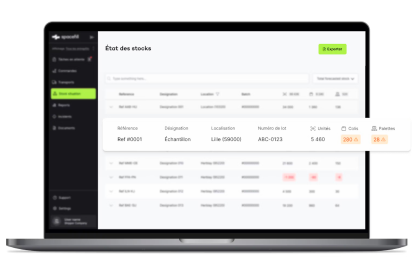
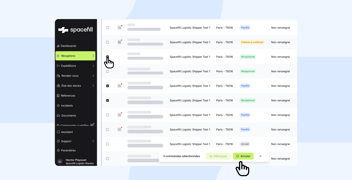
As described in the webinar, the portal gives customers access to:
- stock levels
- orders
- deliveries
- documents
- claims and disputes
- structured collaboration (reducing email dependency)
Beyond that, Spacefill supports EDI/API connectivity and integrates with third-party tools in a middleware approach: aggregating data from multiple systems (WMS, transport tracking, ticketing tools, etc.) and presenting a unified view to the end customer.
The trigger: Growth and the need to “level up”
For DSL, this was not about following a trend. It was driven by operational necessity linked to growth.
As the company expanded, Renaud realized it needed to cross a new threshold on three dimensions:
- team organization and skill development
- customer expectations and follow-up
- overall interaction and 360° visibility
He describes it metaphorically as a “three-blade razor”: not just one improvement, but multiple levels of evolution at once — rigor, customer relationship, and scalability.
Integration & onboarding: A double approach, configuration, and discipline
A key question during the webinar was whether each new client requires heavy support.
On Akanea’s side, clients are trained to become autonomous in onboarding their own customers, though project teams can assist when needed.
From DSL’s perspective, onboarding involves a two-step integration process:
- Integration within Akanea WMS X-tent (already well mastered internally)
- Specific integration within Spacefill, requiring additional discussion and configuration with the client
Why this extra step? Because complexity varies significantly between customers.
Some clients send high volumes of standardized orders. Others send Excel files with 25, 30, or 50 lines that must be processed accurately in one go. This is where configuration and method matter most.
Renaud highlights the importance of structured follow-up and support:
“We can thank the Spacefill teams, especially Lucie, who never let go.”
Renaud, DSL
The key takeaway: implementation requires discipline, a roadmap, and consistency. “You must not let go.”
What DSL changed in daily operations
This is where the feedback becomes most tangible.
Fewer emails, fewer calls, fewer misunderstandings
Renaud clearly lists the impact:
- fewer emails
- fewer phone calls
- less wasted time
- fewer misunderstandings
The goal is not to reduce human interaction, but to eliminate operational noise and focus conversations on value-added discussions.
Less manual entry, more control and follow-up
DSL wanted to move away from repetitive manual entry and administrative tasks toward:
- operational control
- structured follow-up
- proactive customer engagement
In a growth context, this shift is critical. Without it, teams risk being overwhelmed by transactional tasks.
Greater autonomy — for customers and teams
Autonomy is a central benefit on both sides.
“It makes the customer autonomous and it also makes our teams autonomous in managing the customer.”
Renaud, DSL
Customer autonomy: direct access to information and structured collaboration.
Team autonomy: centralized data and clearer processes to manage accounts more efficiently.
A more structured internal organization
Renaud also describes internal reorganization. This was not about reducing headcount, but about optimizing workflows, especially within the sales administration (ADV) function, which now interacts with clients in a more structured and proactive way.
ROI: Organizational first, financial later
When asked about return on investment, Renaud’s response is pragmatic.
At this stage, the ROI is primarily organizational:
- deeper organizational transformation
- questioning and improving daily processes
- time savings (even if difficult to quantify during growth)
- faster client onboarding
- more precise order and customer monitoring
Financial ROI is expected in a second phase, once processes and adoption mature.
For logistics and IT decision-makers, this is a key insight: in WMS + customer portal projects, ROI can be progressive — first operational and structural, then financial.
Rigor: The common thread
In closing, Renaud emphasizes one word repeatedly: rigor.
“There’s one word that comes to mind: rigor. (…) We gain rigor, professionalism, and better exchanges with the customer.”
Renaud, DSL
For DSL, both WMS X-tent and Spacefill contributed to this rigor — in file integration, process monitoring, and roadmap execution.
As companies scale, rigor becomes a competitive advantage: faster onboarding, more reliable follow-up, and stronger customer retention.
Key Takeaways
- WMS X-tent provides execution and traceability — the operational backbone.
- Spacefill’s logistics customer portal adds collaboration, autonomy, and digital customer experience.
- DSL’s trigger was growth and the need to level up interaction and follow-up.
- Concrete gains include fewer emails, less manual entry, better control, and stronger customer exchanges.
- The recurring theme: rigor — as a driver of skill development and service quality.
Conclusion
Are you a 3PL already equipped with a WMS but feeling the pressure of increasing digital expectations, more demanding customers, and growing operational complexity?
Spacefill connects to Akanea WMS X-tent to add a customer portal / control tower layer: stock visibility, order tracking, deliveries, documents, claims management, and a flexible EDI/API connectivity strategy tailored to your ecosystem.
Book a demo and discuss your onboarding processes, your sales administration workflows, and your shipper–3PL collaboration strategy.