Inventory management has become a strategic challenge for companies operating across multiple sales channels, outsourcing their logistics, or working with several warehouses. In this context, having a high-performing Inventory Management System (IMS) is essential to control stock levels, secure the customer promise, and manage costs.
However, logistics organizations have evolved significantly. Inventory is now spread across multiple locations, often managed by third-party logistics providers (3PLs), and handled through heterogeneous systems (ERP, OMS, WMS, e-commerce CMS). The challenge is therefore no longer just choosing an IMS, but ensuring a reliable, shared inventory view across the entire logistics ecosystem.
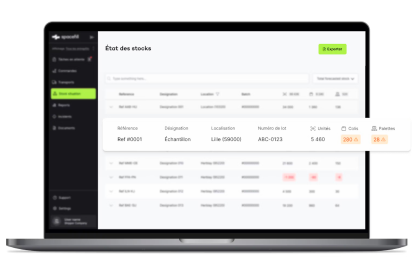
Spacefill positions itself as a next-generation IMS, designed for multi-warehouse and multi-3PL environments. Spacefill acts as a stock synchronization and visibility layer, capable of connecting IMS modules integrated within broader systems (ERP, OMS) as well as existing WMS platforms, including those used by logistics providers. It enables companies to fully leverage their inventory management, even in outsourced and complex logistics environments.
In this article, we present a Top 10 IMS solutions to know, to better understand the market and today’s inventory management challenges.
1. NetSuite Inventory Management
An IMS integrated into the NetSuite ERP, widely used by fast-growing companies.
It provides centralized inventory management with advanced tracking and reporting capabilities.
2. SAP Inventory Management (S/4HANA)
A robust solution designed for large enterprises.
SAP supports high inventory volumes, often in international and multi-site environments.
3. Odoo Inventory
An inventory management module integrated into the Odoo ecosystem.
Flexible, modular, and widely adopted by structured SMBs.
4. Zoho Inventory
An accessible and easy-to-use IMS, often chosen by e-commerce or omnichannel businesses.
A strong balance between functionality and usability.
5. Cin7
An e-commerce and omnichannel-focused IMS, offering numerous integrations with marketplaces and sales tools.
Frequently used to synchronize inventory across multiple channels.
6. Brightpearl
A solution designed for retail and omnichannel commerce.
Brightpearl combines inventory, order management, and financials within a single platform.
7. Linnworks
A multichannel IMS/OMS specialized in marketplace-driven businesses.
It enables centralized inventory management across multiple sales channels.
8. Unleashed Software
An IMS focused on distribution and supply chain operations, with strong capabilities around cost tracking and lot management.
9. Fishbowl Inventory
A more technical solution, often used in industrial or manufacturing environments.
10. Acctivate Inventory Management
A robust IMS for B2B or high-volume businesses, offering advanced reporting and forecasting features.
Where Does Spacefill Fit In?
Spacefill is not an IMS in the traditional sense, and that is precisely where its value lies.
While an IMS manages inventory within a single system, Spacefill acts as an inventory synchronization and visibility layer across multiple systems, including:
- IMS
- WMS
- OMS
- third-party logistics providers (3PLs)
In multi-warehouse and multi-3PL environments, Spacefill enables companies to:
- consolidate inventory from multiple IMS or WMS platforms
- ensure real-time, reliable inventory data
- share a unified inventory view between brands and logistics partners
- feed OMS platforms and sales channels with accurate data
Spacefill does not replace an IMS—it connects it to operational reality.
Conclusion
There are many powerful IMS solutions on the market, each suited to specific contexts.
But once logistics operations become distributed or outsourced, performance no longer depends on an IMS alone, but on its ability to be connected and synchronized across the entire logistics ecosystem.
This is where Spacefill positions itself as a key complement to IMS platforms, bringing visibility, orchestration, and collaboration where traditional tools reach their limits.
FAQ



.%20Un%20vaste%20espace%20organis%C3%A9%20avec%20des%20rayonnages%20m%C3%A9talliques%20re%20(1).webp?width=352&name=DALL%C2%B7E%202025-01-24%2012.15.39%20-%20Une%20sc%C3%A8ne%20moderne%20repr%C3%A9sentant%20un%20entrep%C3%B4t%20logistique%20de%20type%203PL%20(Third-Party%20Logistics).%20Un%20vaste%20espace%20organis%C3%A9%20avec%20des%20rayonnages%20m%C3%A9talliques%20re%20(1).webp)


